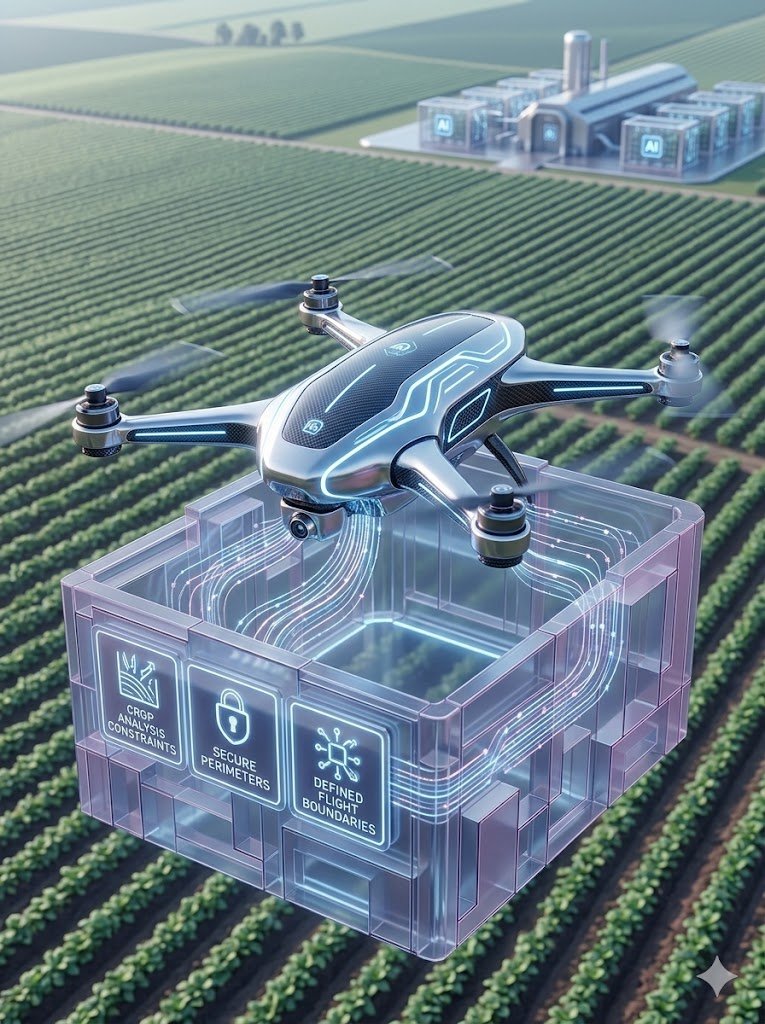
The age of agricultural automation is accelerating, and drones—once simple tools for aerial imagery—are now transforming into autonomous intelligence systems that can manage vast expanses of farmland. As global food demand climbs and workforce shortages deepen, smarter drones are stepping in as the digital stewards of mega farms, offering precision, speed, and data-driven decision-making. The evolution of these flying AI systems marks a powerful leap forward for scalable and sustainable farming.
Quick note: Want to automate your operations with AI? Check our [Solutions].
Smarter Drones Transform Operations on Mega Farms
Across large agricultural holdings, drones are becoming indispensable partners in crop management. They are now capable of conducting autonomous flight routes, recognizing crop stress, detecting pests, and even predicting yield outcomes with minimal human intervention. Equipped with multispectral sensors and advanced onboard processors, these drones can scan thousands of hectares faster and more accurately than any ground-based team, capturing crucial environmental data in real-time.
The data collected by these intelligent aerial systems feeds directly into centralized farm management platforms powered by machine learning algorithms. Farmers can then visualize growing conditions, optimize irrigation schedules, and apply fertilizers or pesticides exactly where needed—eliminating waste and maximizing output. For large commercial farms, scalability is no longer just a logistical ambition but a technological reality, where every hectare is monitored by an ever-learning swarm of AI-assisted drones.
Moreover, smart drones are reducing operational costs while improving sustainability metrics. By pinpointing problem areas early, these systems prevent large-scale crop loss and minimize chemical use, addressing both environmental and economic concerns. The efficiency curve on mega farms is being redrawn—not by sheer labor expansion, but by precision-driven intelligence flying steadily across the skies.
AI Autonomy Ushers in the Next Phase of AgTech Evolution
The shift toward autonomous AI drones represents a new cognitive layer in agricultural systems. Unlike earlier versions reliant on manual operation, the latest generation of drones leverage neural network models to make real-time decisions about terrain, weather, and plant health. Their behavioral intelligence allows them to adapt mid-flight, avoiding obstacles, recalibrating routes, and diagnosing complex field variations without waiting for remote commands. This emergence of autonomy marks a turning point from human-guided technology to self-managing agricultural ecosystems.
At the core of this evolution are embedded AI agents – digital co-farmers with the ability to learn, predict, and collaborate. They form decentralized networks of observation and action, sharing insights across the farm’s digital grid. This interconnected intelligence is shaping a new paradigm where farms function as living systems directed by coordinated AI swarms. The result is a fusion of biology and computation, enabling resilient crop systems and more intelligent resource distribution.
As these autonomous systems mature, their role extends beyond monitoring toward predictive governance of entire agricultural cycles. The farm of the future won’t simply react to data—it will forecast, plan, and self-correct. Drones will act not as tools but as autonomous agents, each contributing to the farm’s collective intelligence, ensuring every resource—from water to sunlight—is used optimally. This convergence of AI autonomy and agriculture will define the next frontier of AgTech economics.
The intelligence now embedded into aerial farming fleets signifies a broader transformation in how we conceive autonomy in agriculture. Smarter drones are no longer peripheral technologies; they are central nodes in the vast digital nervous system of global food production. For innovators and strategists at Universe Agentic’s horizon, the takeaway is clear: the next competitive edge in AgTech will come not from scale alone, but from the deployment of autonomous intelligence that continuously learns, adapts, and evolves alongside the land it serves.
Ready to lead the AI revolution in your industry? Universe Agentic builds custom autonomous ecosystems that turn complex data into measurable results. [Explore our AI Solutions]
Very good post, thanks so much!