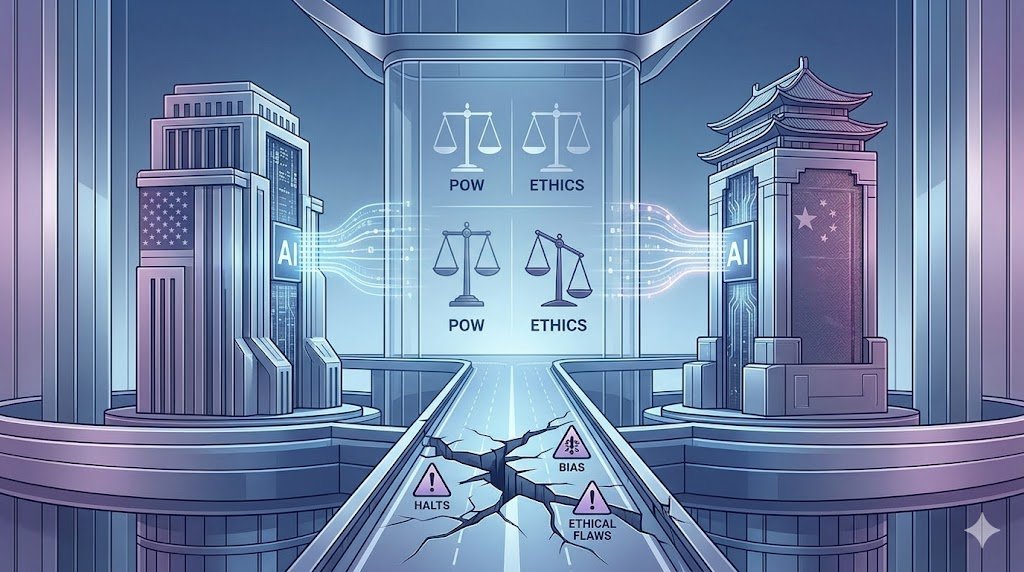
The race between the United States and China to dominate artificial intelligence has evolved beyond research breakthroughs or raw compute power. Over the past year, both countries have achieved a remarkable balance in autonomous AI capabilities — closing what was once a wide technological gap. Yet, as the innovation divide narrows, another disparity grows sharper: the gap in responsible AI governance. Universe Agentic explores what this dual reality means for the future of agentic automation and global AI strategy.
Quick note: Want to automate your operations with AI? Check our [Solutions].
US and China reach parity in autonomous AI power
It’s no longer a question of who leads in AI development, but how each power deploys it. Between the United States’ ecosystem of open innovation and China’s state-engineered AI infrastructure, both nations have reached a point where autonomous systems — agents that can reason, act, and self-optimize — perform at comparable levels. The U.S. continues to benefit from its density of private sector innovation, where companies rapidly iterate models through competition and collaboration. Meanwhile, China’s centralized approach has enabled fast integration of agentic AI into manufacturing, logistics, and governance systems.
The closure of this AI capability gap has reshaped the global economic landscape. Silicon Valley’s open-source movement has inspired Chinese developers to experiment and iterate at unprecedented speed, while U.S. firms have discreetly followed the efficiency patterns seen in China’s AI-Autonomy pipelines. The result is a bilateral ecosystem of parity — two technical civilizations converging on similar AI architectures, albeit with different control philosophies.
However, parity in power does not mean parity in purpose. While the acceleration of autonomous models brings a new era of agentic decision-making, neither nation seems prepared to synchronize on systemic safeguards. Behind every newly matched benchmark lies an ethical gap — a divergence not of code, but of conscience.
But ethics and transparency remain worlds apart
Where America preaches “responsible innovation,” China promotes “secure development.” The distinction is subtle but profound. In the U.S., the debate centers on transparency, open oversight, and accountability — principles championed by academia and civil watchdogs. In China, responsible AI is contextualized through social harmony and alignment with national objectives. Each government defines “safety” differently — one as a democratic duty, the other as an instrument of stability. That divergence creates friction when agentic systems interface across borders, from multinational supply chains to global AI regulation forums.
As autonomous AI agents grow capable of making real-world decisions — from financial trading to defense logistics — the absence of shared ethical standards becomes a strategic vulnerability. U.S. corporations warn of closed-door algorithmic practices in China, while Chinese firms point to Western double standards in data usage and surveillance. The irony is that both sides accuse the other of opacity while advancing autonomy faster than their governance frameworks can adapt.
This lack of mutual trust is quietly fragmenting the AI landscape into ideological silos. Developers, once connected through global open-source communities, now face increasing compliance firewalls. The risk isn’t that AI will become uncontrollable — it’s that it will evolve along incompatible moral architectures. For autonomous systems designed to collaborate across networks and jurisdictions, that’s a future even more unstable than technological imbalance.
The US-China AI gap may have closed in technical terms, but the responsible AI gap remains dangerously wide. For the world of autonomous agents, this signals a moment of reckoning. True progress will not come from matching computational horsepower, but from aligning governance, ethics, and intent. Visionary AI does not simply automate intelligence — it embodies collective responsibility. For innovators, regulators, and strategists, the next frontier is not just building smarter agents, but ensuring they serve humanity with integrity across every border.
Ready to lead the AI revolution in your industry? Universe Agentic builds custom autonomous ecosystems that turn complex data into measurable results. [Explore our AI Solutions]