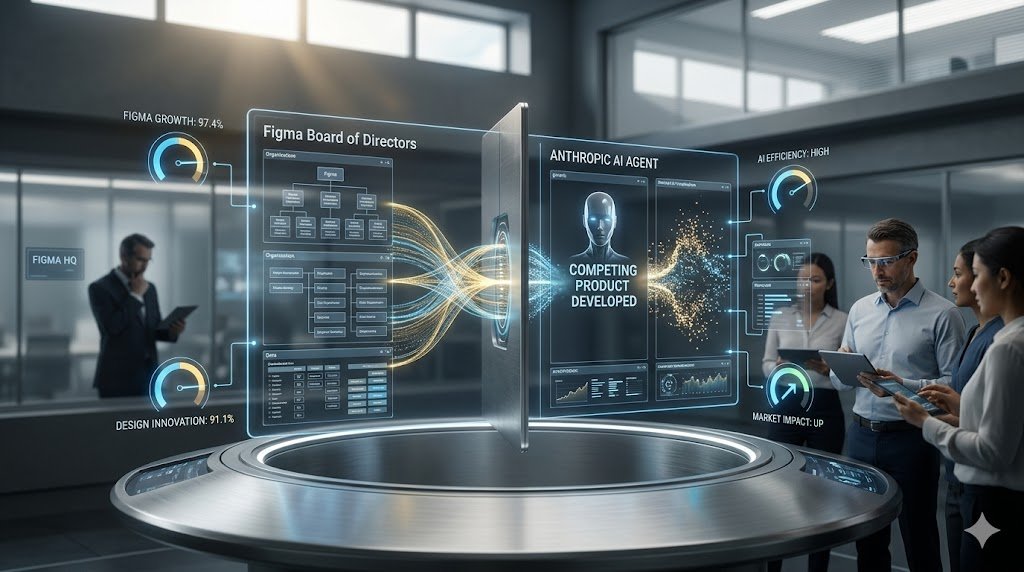
The technological landscape is shifting once again as a prominent figure in the AI world steps back from a major design company’s leadership circle. Anthropic’s Chief Product Officer has officially left the Figma board following reports that he plans to introduce a product that may directly compete with Figma’s design platform. This move not only highlights growing tensions between AI innovators and creative toolmakers but also offers a glimpse into how autonomous AI systems are beginning to reshape the boundaries of collaboration and competition in tech.
Quick note: Want to automate your operations with AI? Check our [Solutions].
Anthropic’s CPO exits Figma board amid competition buzz
The departure of Anthropic’s CPO from Figma’s board underscores a deepening divide in how companies navigate conflicts of interest as AI capabilities become increasingly transformative. While Figma remains a central hub for human-centered design collaboration, Anthropic is moving swiftly toward advancing AI systems capable of generating, iterating, and refining designs autonomously. If the rumors of a new competing product bear fruit, the lines between creative co-pilot and complete AI designer could blur faster than expected.
This development also signals the tightening race to own the junction where AI meets user creativity. Figma has long represented the collective spirit of design thinking—teams ideating together in shared digital spaces. Yet Anthropic’s vision hints at a world where intelligent agents not only assist designers but also conceptualize entire interfaces from scratch. The shift from human-guided collaboration to AI-envisioned creation could redefine what “design tools” mean in the coming decade.
Industry observers see the CPO’s exit as more than a governance formality—it’s a signal flare. By distancing itself from Figma’s board, Anthropic gains the strategic freedom to pursue autonomous creative systems that could internalize the entire design process. In essence, the move reflects a changing ethical calculus in tech diplomacy: innovation cannot be restrained by boardroom allegiances when the competitive edge lies in teaching AI to imagine.
What this power shift means for the era of AI autonomy
The exit marks another chapter in the broader story of how major tech players maneuver within the rapid evolution of AI autonomy. It exemplifies how AI-focused companies are increasingly positioning themselves as ecosystem builders rather than mere service providers. If Anthropic indeed unveils a design-oriented AI platform, it could redefine productivity for creative organizations—introducing agents that interpret human intent, design accordingly, and continuously improve through feedback loops.
Such advancements are more than just incremental. They embody a philosophical transition from reactive AI—tools that respond to prompts—to proactive AI—entities that propose, predict, and optimize toward intent-driven outcomes. The autonomy frontier is no longer about task completion; it’s about context awareness and decision-making at the creative level. This transformation suggests that humans may soon manage design at a systemic layer, overseeing fleets of AI “designers” operating in harmony.
Ultimately, this move hints that corporate hierarchies and AI ecosystems are converging. Leadership departures, like the one at Figma’s board, symbolize how individual visionaries are breaking institutional molds to pioneer new territories of automated intelligence. In a time when creative autonomy itself is being redefined by algorithms, each organizational shift can ripple across the entire AI economy, signaling what the next evolution of intelligent collaboration might look like.
The Anthropic CPO’s exit from Figma’s board is more than a personnel change—it’s a marker of where AI innovation is headed. As companies race to integrate self-directed intelligence into design, we’re witnessing a quiet revolution in how creativity and computation intertwine. For Universe Agentic readers, the message is clear: the age of autonomous creation is not approaching—it’s already here, and the organizations that learn to co-evolve with their own AI agents will lead the next era of digital ingenuity.
Ready to lead the AI revolution in your industry? Universe Agentic builds custom autonomous ecosystems that turn complex data into measurable results. [Explore our AI Solutions]