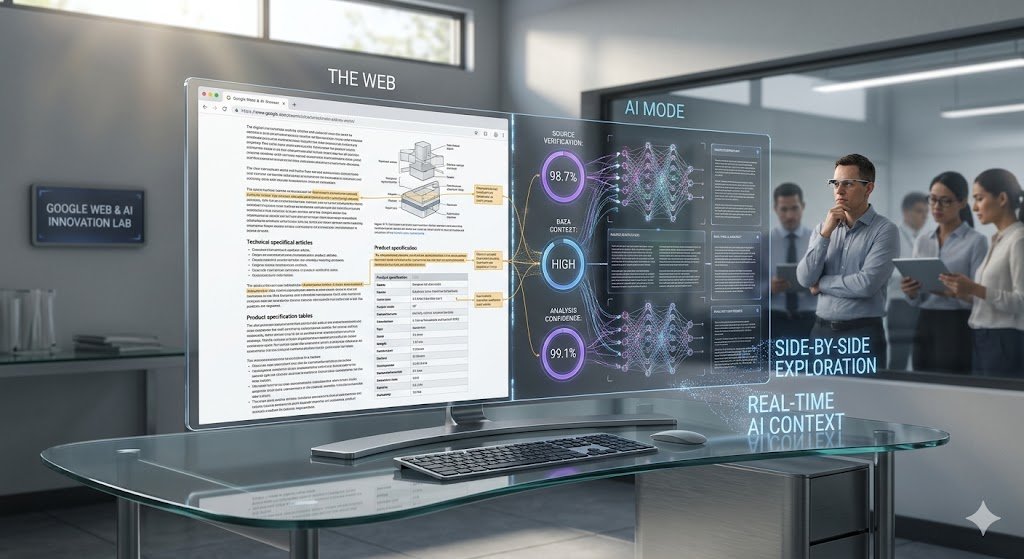
Google’s latest evolution in search—AI Mode—marks a significant shift in how humans interact with the web. By blending generative intelligence with traditional browsing, this new feature allows users to explore online content side-by-side with an AI companion. It’s not just a layer on top of search; it’s a step toward a future where exploration itself becomes a collaborative act between user and algorithm.
Quick note: Want to automate your operations with AI? Check our [Solutions].
Google’s AI Mode Redefines How We Navigate the Web
In this new AI Mode, users can literally browse the web alongside an artificial intelligence that synthesizes, interprets, and contextualizes information in real time. Imagine reading an article, and the AI instantly highlights key concepts, summarizes debates, or suggests related perspectives—all without leaving the page. Google’s interface now lets users toggle between traditional search results and an intelligent partner view, shifting from static querying to an ongoing conversation with information itself.
This side-by-side design fundamentally changes cognitive workflow. Instead of jumping between tabs or relying on sporadic prompts, exploration becomes fluid and guided. The AI acts not as a gatekeeper, but as a research assistant—helping users verify claims, expand horizons, and discern nuance at the speed of thought. For researchers, creators, and professionals, this creates a dynamic zone where comprehension and discovery occur simultaneously.
Beyond convenience, this move signals Google’s deeper ambition: to transform its search platform into a co-evolving ecosystem of shared intelligence. In AI Mode, the line between “searching” and “understanding” blurs. By positioning itself within the user’s cognitive space, Google is reframing the browser as a partner, not just a portal. That shift redefines the modern information experience, introducing a new dimension of agency where humans and algorithms explore in tandem.
A New Era of Agentic Exploration and Human Insight
What sets AI Mode apart is its agentic foundation—the ability for AI to act autonomously within the user’s knowledge pursuit. Rather than waiting for explicit commands, it can propose new angles, connect concepts, and even surface data patterns based on the user’s intent. This context-aware intelligence represents a crucial step toward “Autonomous AI Agents” embedded in everyday tools, bridging the gap between human curiosity and machine reasoning.
Such functionality amplifies human insight. Instead of passively consuming content, users engage in reflective dialogue, where the AI co-constructs meaning and offers refined interpretations of the web’s vast terrain. For enterprise users and innovators, this means acceleration in research, creative iteration, and decision-making—because the AI doesn’t just fetch results; it reasons with them. The user remains the decision-maker, while the agent enriches every layer of analysis.
In the grander scope of AI automation, Google’s AI Mode is a prototype for a new kind of digital symbiosis. It demonstrates how major platforms are preparing for agentic ecosystems—where humans direct, and AI executes, interprets, and evolves. As we move toward an era defined by co-intelligence, such tools will serve as scaffolding for a more integrated web—one in which knowledge emerges not from isolated searches, but from continuous, shared exploration.
Google’s AI Mode doesn’t just expand the boundaries of search—it reimagines the dynamics of inquiry itself. By merging human intent with algorithmic insight, it sets the stage for a future where exploration is both analytical and intuitive. For readers of Universe Agentic, the key takeaway is strategic: as AI becomes increasingly agentic within our workflows, those who learn to collaborate with these systems—rather than merely use them—will define the next evolution of digital intelligence.
Ready to lead the AI revolution in your industry? Universe Agentic builds custom autonomous ecosystems that turn complex data into measurable results. [Explore our AI Solutions]