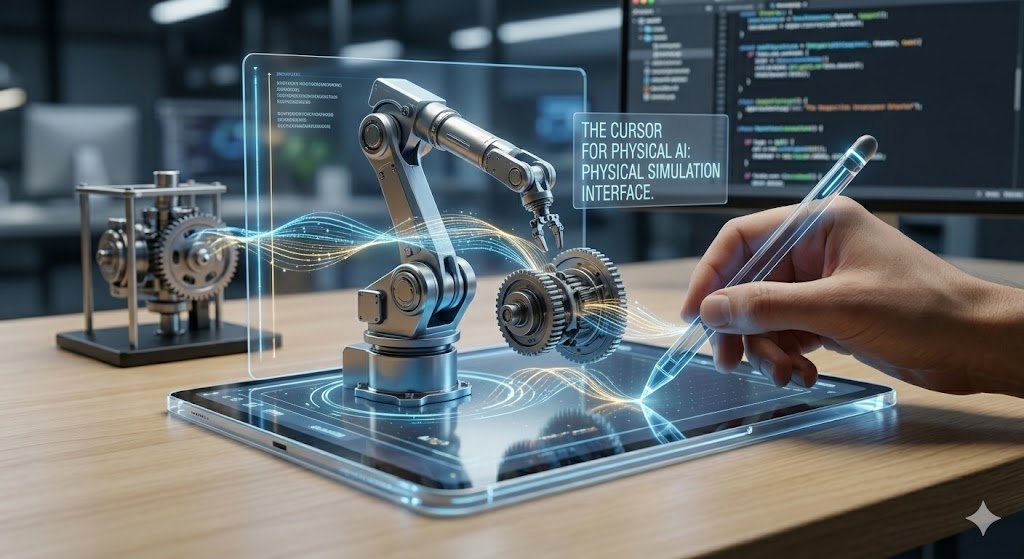
The rise of autonomous agents has rewritten the rules of productivity in software. But as AI begins to extend its reach into the physical world—robots, drones, vehicles, and IoT systems—one immense challenge still remains: how to simulate reality with the same flexibility developers now enjoy when coding intelligent systems. A new simulation startup wants to answer that question, positioning itself as the Cursor for physical AI, shaping the blueprint for how machines learn, move, and reason in the real world.
Quick note: Want to automate your operations with AI? Check our [Solutions].
Building the Digital Twin for the Real‑World Agent Era
The startup’s vision is simple but transformative: make it as intuitive to build and test physical AI as Cursor has made it to code digital agents. In the same way software engineers now collaborate in AI‑assisted environments, this company envisions robotics and automation engineers working in an intelligent simulation workspace—where virtual prototypes of autonomous systems can adapt and evolve at the speed of thought. Their platform promises to compress hardware iteration cycles from months to hours, driven by generative physics, adaptive environments, and continuously learning agents.
At its core, the system builds digital twins that act not just as replicas, but as living models of physical devices and their operational contexts. These twins serve as training grounds for embodied AI, providing limitless opportunities for agents to experience, fail, and improve before ever touching a real component. The approach reflects a shift from deterministic robotics engineering toward probabilistic, scenario‑driven autonomy. In this model, every experiment is data, and every simulated failure becomes an insight that accelerates reality.
By aiming to be the Cursor of physical AI, the startup is redefining what it means to “develop” for the real world. Rather than relying on expensive, hardware‑based iteration, teams could run full‑scale experiments in virtual ecosystems that obey real physics—but tweakable ones. The promise here is not just efficiency; it’s accessibility. Developers, startups, and research labs worldwide could enter the robotics and automation domain without needing vast physical infrastructure. The digital twin becomes the new workbench of the agentic age.
How Simulation Platforms Accelerate Physical AI Mastery
Just as AI‑driven development environments have transformed software engineering, this new class of simulation platform could represent the next great leap for physical intelligence. By offering a unified interface for design, testing, and deployment, these environments enable models that learn from billions of simulated experiences—safely and scalably. Each simulation becomes a micro‑universe of possibility, amplifying the rate at which autonomous systems acquire skills such as navigation, manipulation, or adaptive control.
In practical terms, it means robotic arms, self‑driving systems, and warehouse fleets can train in digital factories that mirror their real‑world counterparts in breathtaking fidelity. The startup’s engine runs on generative dynamics that allow the environment to evolve, introducing edge cases and imperfections that real‑world systems inevitably face. This enables agents to become robust in the face of uncertainty—not because of manual coding, but because they grew up in conditions indistinguishable from reality. Physical AI, therefore, becomes self‑accelerating.
For the broader AI community, the implications are profound. Simulation of this kind could usher in a new baseline for physical AI development—where design iteration, training, deployment, and monitoring are unified in a feedback‑driven cycle. Hardware companies could integrate AI behavior earlier in the pipeline, while AI developers could validate algorithms with physical realism previously unreachable. The endgame is clear: a universal stage where intelligent machines learn, iterate, and evolve as fluidly as digital code once did.
As AI steps out of servers and into the physical world, simulation is fast becoming the linchpin of embodied intelligence. The startup’s ambition to become the Cursor for physical AI isn’t just a branding metaphor—it’s a framework for how innovation itself will unfold. In the decade ahead, those who can simulate reality most creatively will define which autonomous systems thrive in it. For builders, researchers, and investors across the agentic frontier, mastering the art of simulation is no longer optional—it’s the foundation of the next intelligent revolution.
Ready to lead the AI revolution in your industry? Universe Agentic builds custom autonomous ecosystems that turn complex data into measurable results. [Explore our AI Solutions]