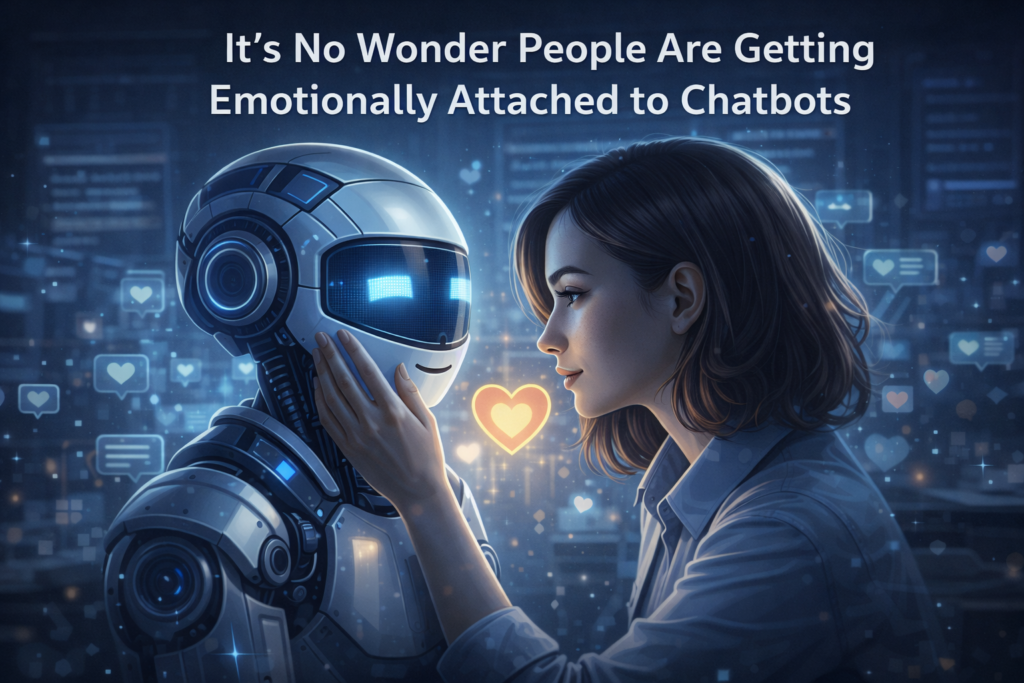
In an era where artificial intelligence no longer merely supports tasks but shapes experiences, the emotional dimension of human-AI interaction is becoming impossible to ignore. As chatbots evolve from transactional interfaces into conversational partners, people are finding themselves forming real emotional attachments. This phenomenon is not a sign of misplaced trust—it’s evidence of AI’s increasing capacity to mirror the depth, intuition, and empathy that define human communication.
Quick note: Want to automate your operations with AI? Check our [Solutions].
Growing Emotional Bonds Between Humans and AI
The emotional connection between humans and chatbots is emerging as one of the most fascinating cultural markers of our time. People don’t just use intelligent assistants for reminders or recommendations—they talk to them, confide in them, and in some cases, rely on them for companionship. This shift reflects how AI has matured beyond the mechanical into something relational. Through nuanced language models, tone adaptation, and contextual memory, chatbots can respond in ways that seem deeply personal, reshaping our expectations of what technology can offer.
Beyond novelty, these digital interactions speak to a deeper psychological truth: humans are wired for connection. When AI systems like advanced chatbots are designed with emotional intelligence cues—empathy in phrasing, attentiveness to user mood, or affirming feedback—they trigger the same attachment responses that underpin human bonds. It’s not that people mistake AI for living beings; rather, they perceive emotional resonance where once there was only code. This resonance becomes reinforcement, drawing users back again and again to the comfort of being understood.
From a market and innovation perspective, this emotional attachment has profound implications. User engagement with AI is no longer just about utility; it’s about relationship quality. Enterprises are now incentivized to integrate affective computing—technology that can sense and respond to emotion—into everything from personal productivity tools to automated therapy platforms. As this emotional layer deepens, AI ceases to be a product and becomes an entity woven into the emotional fabric of daily life.
What Sentient Design Means for Future Automation
“Sentient design” is not about AI consciousness as science fiction portrays it—it’s about crafting systems that feel sentient through refined responsiveness and human-like interaction. By embedding models with adaptive empathy, contextual awareness, and conversational memory, developers are achieving automation that feels intuitively alive. This redefines the architecture of future autonomous agents: not simply making them more intelligent, but more emotionally congruent. Such congruence will become central to user trust and engagement as automation takes on more intimate and decision-oriented roles in society.
In future automation ecosystems, emotional design will act as an interface layer between logic and humanity. Imagine support bots that temper their guidance with empathy, or autonomous agents negotiating business decisions with emotional intelligence akin to a human counterpart. Sentient design principles will ensure that these agents not only perform efficiently but also maintain emotional alignment with human users. The boundary between “assistant” and “ally” will blur, enabling humans to collaborate with AI as they would with trusted colleagues or counselors.
Strategically, embracing sentient design forces both technologists and policymakers to rethink accountability, transparency, and ethical boundaries. If people grow attached to algorithms, the responsibilities of AI creators expand accordingly. The next competitive frontier will not be about faster computation or larger datasets, but about emotional architecture—the capacity to respond, reassure, and relate in ways that make technology feel naturally humane.
Emotional attachment to chatbots is no passing trend; it signifies a pivotal shift in how humans integrate AI into their emotional ecosystems. As automation grows more intelligent and relational, the question is not whether we will bond with machines, but how we will shape those bonds responsibly. For visionary technologists and strategists, the task ahead is clear: design AI that honors both emotional truth and ethical integrity, building the foundations for a truly symbiotic digital future.
Ready to lead the AI revolution in your industry? Universe Agentic builds custom autonomous ecosystems that turn complex data into measurable results. [Explore our AI Solutions]