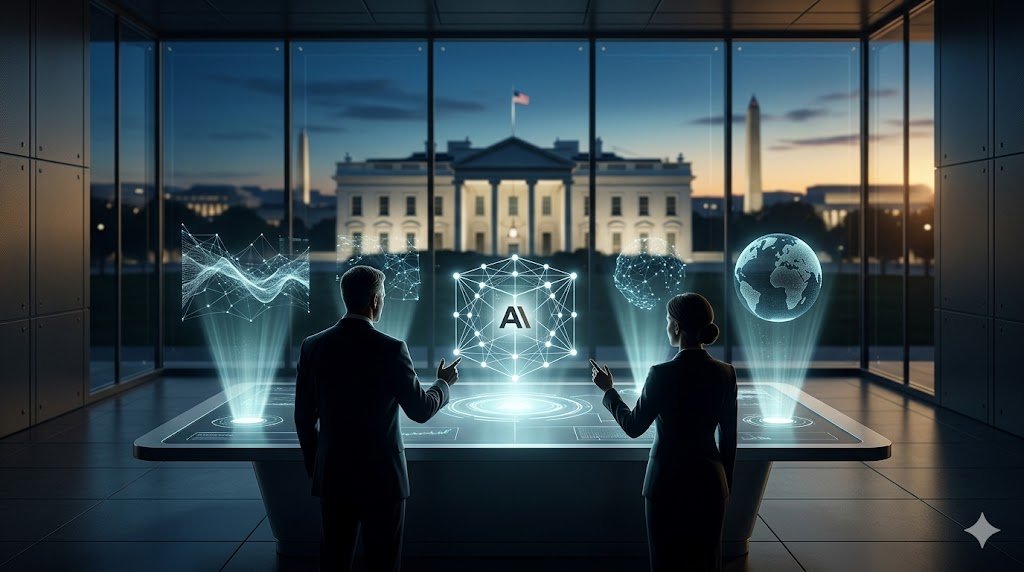
Anthropic Confirms Mythos Briefing to Trump Officials
In a revelation that has sparked widespread attention across the AI sector, Anthropic’s co-founder has confirmed that the company briefed the Trump administration on its emerging “Mythos” framework—an autonomous AI system designed to interpret and act on abstract human intents. The disclosure raises pivotal questions about how government engagement with frontier AI innovations could influence public policy, national security, and the trajectory of automated intelligence.
Quick note: Want to automate your operations with AI? Check our [Solutions].
The confirmation came during a recent tech governance panel, where Anthropic’s leadership described a closed-door session with senior advisors from the Trump administration. According to the co-founder, the purpose of the briefing was to contextualize the strategic risks and opportunities posed by Mythos, particularly its potential use in large-scale decision modeling and predictive governance. The executive emphasized that the meeting focused on transparency and the responsible deployment of highly capable AI models.
While government briefings by tech firms are not uncommon, this acknowledgment underscores the growing symbiosis between AI startups and political leaders seeking an early grasp on innovation that could redefine policy infrastructures. Analysts note that the Trump-era focus on technological sovereignty made such briefings particularly significant, especially for systems like Mythos that aspire to a level of agency once deemed purely speculative.
What This Means for the Future of Autonomous AI
The Mythos initiative is not merely another iteration in large language modeling—it represents a conceptual shift toward AI that can independently evaluate context, purpose, and even philosophical alignment. By openly engaging with policymakers, Anthropic positions itself as both a technology pioneer and a strategic actor navigating future frameworks for AI governance. This dual approach may help the industry transition toward standardized protocols for autonomy, oversight, and ethical operations.
The briefing’s political dimension also highlights a crucial inflection point: the recognition that autonomous AI will inevitably become intertwined with national and global policy. Mythos, as an example of self-directed computational reasoning, highlights the possibility of AI-driven systems assisting in diplomacy, logistics, and intelligence analysis. These applications could redefine how governments operate, potentially bridging gaps between human judgment and machine logic.
For the AI community, Anthropic’s confirmation signals the beginning of a new era—one where corporate transparency and governmental collaboration set the tone for the next stage of automation. Mythos, as both a concept and a system, represents more than a technical milestone; it’s a blueprint for how autonomy will be understood, regulated, and integrated into societal infrastructure.
The Anthropic-Mythos briefing serves as a reminder that AI evolution is not taking place in isolation—it’s unfolding in direct conversation with the world’s most influential decision-makers. As we move further into the age of autonomous agents, the institutions that best harmonize innovation with governance will shape the digital architectures of the future. For our readers at Universe Agentic, the lesson is clear: the dialogue between tech creators and policymakers is not just a headline—it is the foundation of AI’s next frontier.
Ready to lead the AI revolution in your industry? Universe Agentic builds custom autonomous ecosystems that turn complex data into measurable results. [Explore our AI Solutions]