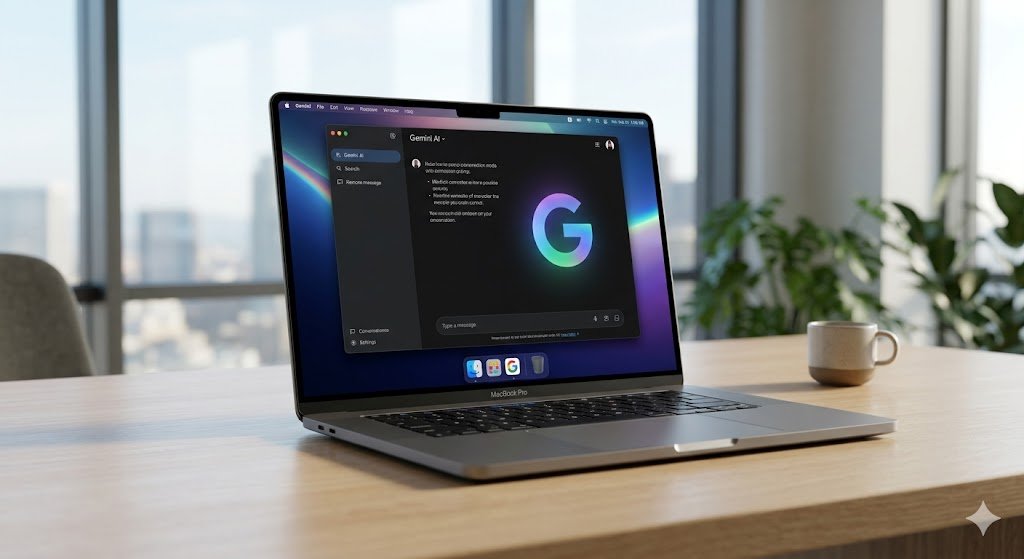
Google Brings Gemini Natively to macOS Ecosystem
Google has officially introduced a native Gemini app for Mac, marking a significant step in its ongoing mission to make AI assistance universal, seamless, and deeply integrated into users’ daily workflows. For the first time, macOS users can experience Google’s Gemini directly on their desktops — not through a browser or an extension, but as a system-level application built to run natively and leverage Apple’s hardware and UI ecosystem.
Quick note: Want to automate your operations with AI? Check our [Solutions].
The arrival of Gemini on macOS signals more than just a software release; it represents a philosophical alignment between local computing power and cloud-driven intelligence. Gemini’s macOS app can now interact with system files, productivity tools, and contextual user data in real time, enabling it to assist users in both creative and operational tasks. This local integration also improves latency, privacy, and personalization — critical features in an era where users demand both intelligence and autonomy from their digital assistants.
For Google, this release is a statement of intent in a highly competitive AI landscape. While Apple pushes ahead with its own AI features through macOS and Siri, and OpenAI works on cross-platform assistants, Google’s decision to embed Gemini natively into desktop environments suggests a long-term strategy: to expand the presence of its generative AI ecosystem beyond the browser and Android devices, solidifying Gemini as a daily, professional tool for creators, developers, and strategists.
A New Era of AI Automation Begins on the Desktop
With Gemini now running natively on macOS, the lines between operating system and intelligent assistant begin to blur. Users can drag files into Gemini to summarize content, generate code snippets, draft documents, or organize projects — all without switching tabs or relying on web connectivity for every small task. The app’s local processing abilities, supported by Google’s hybrid AI architecture, mean that some requests can be handled on-device for speed and data security, while complex queries still benefit from the vast computational power of Google’s cloud infrastructure.
For businesses and professionals, this new model opens the door to unprecedented desktop automation. Imagine a content creator asking Gemini to instantly edit, tag, and optimize images for multiple platforms, or a software engineer prompting it to refactor code directly in Finder. These capabilities redefine productivity by merging conversational AI with system-level functionality — an essential step toward AI agents that autonomously manage workflows instead of simply responding to prompts.
This also signals a strategic inflection point in the competitive AI ecosystem. Google’s push onto macOS amplifies its ambition to lead the future of agentic computing — where intelligent systems proactively learn user behaviors and initiate actions across apps and platforms. With Gemini gaining native access to one of the most influential desktop environments in the world, the stage is set for a new wave of agent-based automation that could reshape how users think about the role of an operating system itself.
The rollout of the Gemini Mac app is more than a product update — it’s the dawn of AI-native desktops. By embedding advanced intelligence directly into macOS, Google is laying the foundation for a new relationship between humans and machines: one where digital agents don’t just answer questions but actively co-create and manage ideas. At Universe Agentic, we see this as a major stride toward the next paradigm of human-computer synergy — the era of autonomous, contextually aware AI companions built not just to assist but to collaborate.
Ready to lead the AI revolution in your industry? Universe Agentic builds custom autonomous ecosystems that turn complex data into measurable results. [Explore our AI Solutions]