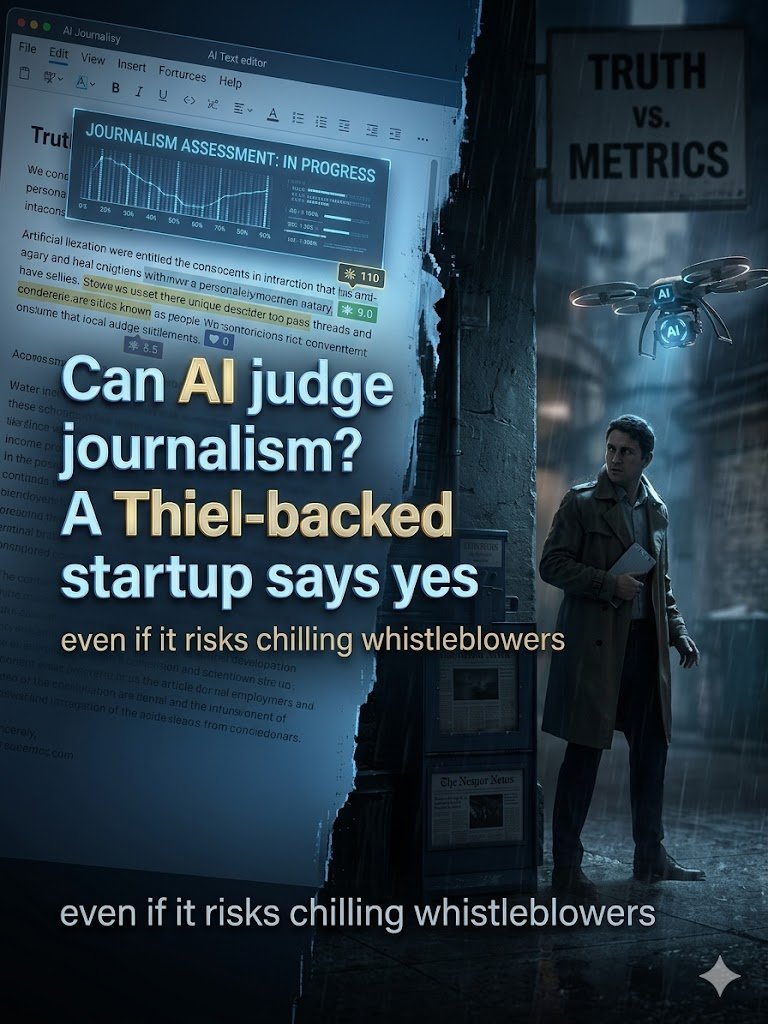
A new frontier in journalism is being tested—and not by reporters, but by algorithms. A Thiel-backed startup claims its AI can “judge” journalism, automatically rating news credibility, assessing bias, and flagging potential misinformation. It’s a bold leap toward merging machine learning with media ethics, but one that raises profound questions about transparency, accountability, and the very soul of investigative reporting.
Quick note: Want to automate your operations with AI? Check our [Solutions].
When AI Becomes the New Editor in Chief
The concept of AI as an editorial authority is no longer hypothetical. The startup, funded in part by venture capitalist Peter Thiel, is developing systems that can evaluate and score news stories in real time. Its models analyze word choice, sourcing patterns, and sentiment variations to determine how “trustworthy” a piece of journalism is presumed to be. The business proposition is clear: With information overload straining human editors, AI offers scalable oversight that can process millions of articles faster—and ostensibly, more objectively—than any newsroom staff.
Yet, the brilliance of automation is shadowed by risk. If machine systems replace human judgment in verifying truth, the press could lose one of its foundational strengths—the ability to interpret nuance, context, and moral complexity. An AI may detect patterns of disinformation, but can it recognize the ethical courage in a whistleblower’s anonymous testimony? The danger is not that machines are malicious, but that they are blind to humanity’s messy truths.
For autonomous AI agents, this technological experiment is a watershed moment. It could redefine editorial workflows, where machine intelligence acts as a “second check” or even a gatekeeper. The startup’s vision aligns with broader industry efforts to create a more resilient information ecosystem, but its implications stretch further. The more AI assumes editorial power, the closer we drift toward an era where storytelling itself becomes quantifiable—and potentially, controllable.
The Ethics of Letting Algorithms Judge Truth
Allowing an algorithm to judge journalism introduces ethical paradoxes that humanity has barely begun to unpack. On one hand, trust in news media is at historic lows, and a neutral, data-driven arbiter could bring accountability where legacy institutions have faltered. On the other hand, bias doesn’t simply vanish when embedded in code—it mutates. Training data, model weighting, and commercial incentives all shape AI behavior, potentially enforcing invisible ideological filters masked as objectivity.
The deeper concern emerges around whistleblowers and investigative reporters who often rely on secrecy and ambiguity to expose power. If an AI scoring system downranks their work because it lacks “verified” sources or deviates from consensus narratives, it could discourage the very journalism society most needs. Machine-led verification might inadvertently privilege official voices over dissent, chilling the flow of uncomfortable truths in the name of automated accuracy.
For the AI agent ecosystem, these dynamics highlight the urgent need for governance frameworks that reconcile automation with autonomy. The future of AI-judged journalism isn’t just about better algorithms—it’s about designing ethical architectures that preserve democratic discourse. As autonomous systems evolve from analyzing stories to influencing them, professionals across media and AI must collaborate to ensure that the next “editor in chief” doesn’t sacrifice courage for compliance.
The Thiel-backed startup’s vision forces us to confront a pivotal question: Who—or what—gets to define truth in the age of autonomous intelligence? As AI technologies become more powerful arbiters of public perception, their creators shoulder an immense responsibility to balance precision with principle. For innovators and strategists shaping the next generation of AI agents, the lesson is clear: the future of truth cannot merely be computed—it must be consciously designed.
Ready to lead the AI revolution in your industry? Universe Agentic builds custom autonomous ecosystems that turn complex data into measurable results. [Explore our AI Solutions]