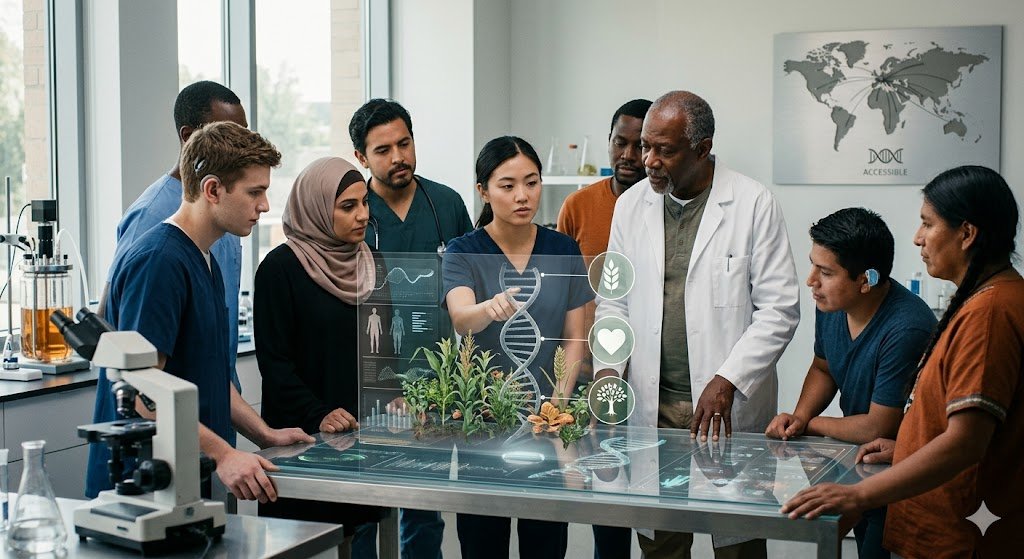
The rise of gene editing stands at the frontier of biology, technology, and artificial intelligence. As tools like CRISPR evolve alongside autonomous AI systems, humanity faces a new kind of digital-biological convergence—one where editing genomes could become as programmable as writing code. Yet, with great potential comes an urgent ethical crossroads: Who will have access to these transformative capacities? “Gene Editing Needs to Be for Everyone” is not just a slogan; it’s a moral and strategic imperative for the future of equitable automation.
Quick note: Want to automate your operations with AI? Check our [Solutions].
Democratizing Gene Editing in the Age of AI
Gene editing has transitioned from speculative science fiction to a practical toolkit capable of reshaping agriculture, medicine, and human biology. The integration of AI-driven models into genetic design is accelerating discoveries at unprecedented speed. However, this acceleration risks concentrating power among a small consortium of biotech giants and elite research networks. Democratizing access means ensuring that developing nations, public institutions, and decentralized AI research networks share in the benefits of this scientific revolution.
The convergence of AI with gene editing is driven by automation—algorithms that can predict genetic interactions, simulate molecular behavior, and optimize editing precision far beyond human capacity. Autonomous AI agents are now routinely tasked with designing new genes for crops resistant to climate change or therapies targeting genetic disorders. Still, the question looms large: will these tools remain open and interoperable, or will they become proprietary gates that replicate the same inequalities seen in digital technology?
For gene editing to truly serve humanity, openness must be built into its algorithms and governance frameworks. Shared protocols, transparent data ecosystems, and federated learning systems can enable communities around the world to customize biological solutions to local problems. In this vision, the democratization of gene editing parallels the open-source movement that once unlocked the full potential of AI development. Accessibility isn’t merely a technical goal—it’s a prerequisite for ethical innovation.
Equitable Innovation as the Future of Automation
As automation expands through both robotics and synthetic biology, the divides between “who controls” and “who benefits from” innovation are widening. In an economy increasingly steered by autonomous AI agents, the tools of creation themselves must be equitably distributed. Gene editing represents one of the most consequential of those tools. Without equitable frameworks, we risk embedding inequality at a biological level, turning genetic access into a new form of social stratification.
Equitable innovation means constructing hybrid ecosystems where AI doesn’t replace human creativity but amplifies it across borders and income levels. Imagine a near future where decentralized AI platforms collaborate with local genetic labs to solve regional health and food security challenges. These automated agents could safely propose genome modifications, simulate the outcomes, and recommend ethical pathways—all while adhering to shared global standards. Such integration would redefine empowerment in the era of bio-automation.
To build this future, policy, technology, and culture must evolve in synchronized motion. Governments need to enable regulatory sandboxes that support safe experimentation. AI developers should embed fairness models into the algorithms that guide genetic design. Civil society must demand transparency and equitable access as a fundamental right. The intersection of AI and gene editing will not only redefine medicine—it will redefine what it means to innovate inclusively in an automated world.
Gene editing, empowered by AI automation, will shape the next century’s biological and economic paradigms. But its promise will remain incomplete if access is limited to a privileged few. Democratization isn’t only a matter of fairness—it’s a strategic necessity for planetary resilience and technological progress. For readers of Universe Agentic, the insight is clear: the companies, nations, and researchers who make gene editing universally accessible will define the next frontier of human agency and automated intelligence.
Ready to lead the AI revolution in your industry? Universe Agentic builds custom autonomous ecosystems that turn complex data into measurable results. [Explore our AI Solutions]