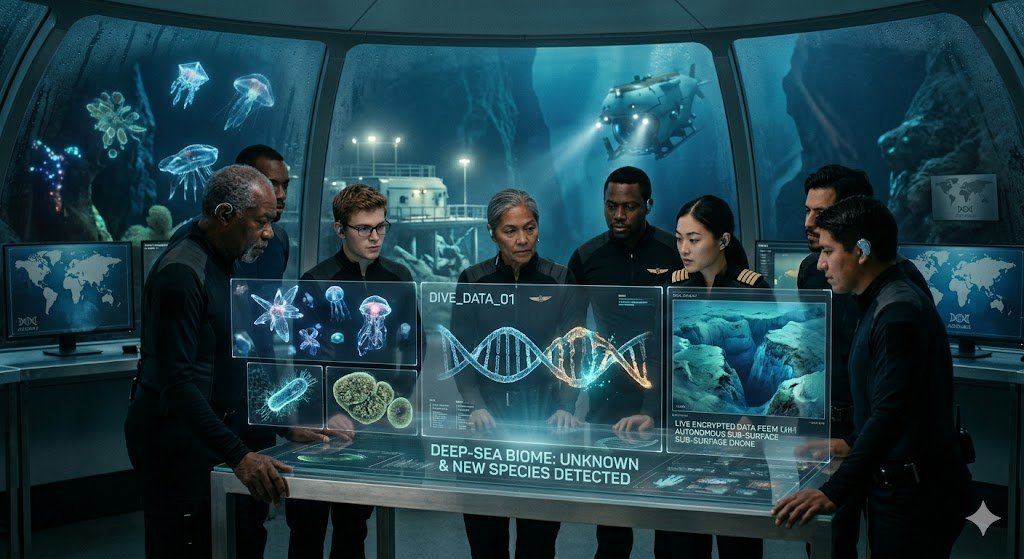
The ocean—the planet’s final and most enigmatic frontier—is about to be unveiled through the lens of intelligent automation. For centuries, humanity has sailed on the surface, gazing into waters whose depths conceal more questions than answers. Now, with the rise of autonomous AI agents, our ability to map, study, and understand these vast undersea realms is advancing faster than ever before. This convergence of artificial intelligence and oceanic exploration isn’t merely about new technology—it’s about unlocking a future where machines don’t just assist discovery but lead it.
Quick note: Want to automate your operations with AI? Check our [Solutions].
AI Dives Beneath the Waves to Decode the Deep
Artificial intelligence is transforming oceanography from a human-led pursuit into a machine-augmented odyssey. With AI systems capable of interpreting environmental data in real time, researchers can now go beyond passive monitoring to active understanding. These intelligent algorithms don’t just collect sonar or chemical data—they contextualize it, identifying new species, detecting micro-ecosystem shifts, and even predicting undersea seismic activity before humans perceive it. What was once a mystery locked beneath miles of dark water is becoming a vivid map of life and motion, drawn autonomously by learning systems that grow more perceptive with every dive.
Beneath the waves, thousands of autonomous underwater vehicles (AUVs) now operate without the constant command of human pilots. By leveraging reinforcement learning and adaptive decision-making models, these agents learn to navigate unpredictable underwater terrains where GPS signals fade and communication lags. They mimic the problem-solving instincts of marine animals—dolphins, octopuses, and fish schools—but powered by synthetic cognition. This shift from manual exploration to self-directed intelligence marks a profound moment where the deep ceases to be an unreachable frontier and becomes an evolving digital ecosystem.
The implications ripple far beyond science. Energy companies, climate researchers, and marine conservationists are harnessing these AI agents to gather insights at speeds impossible a decade ago. As machine learning architectures become more efficient, they compress terabytes of oceanic data into actionable knowledge—fueling breakthroughs in sustainable fisheries, carbon capture, and ocean-based renewable energy systems. The ocean’s secrets are not only being revealed—they’re being translated into a new language of ecological understanding written by AI itself.
Autonomous Agents Chart the Future of Ocean Discovery
Autonomous agents are not just tools for exploration—they are architects of an entirely new mode of scientific discovery. In the near future, fleets of these ocean-smart machines will operate in symbiotic networks, communicating and coordinating without direct human input. Together, they will map the seabed, trace shifting currents, and monitor biodiversity with a precision humanity could never achieve manually. Each dive adds to a shared intelligence, a living network that evolves as it learns from the world’s most mysterious environment.
This evolution represents a deeper philosophical shift for AI automation. Oceanic exploration has long symbolized humanity’s thirst for the unknown; now, it also represents AI’s entry into true autonomy. The same frameworks guiding these underwater agents—model-based reasoning, environmental adaptation, cooperative sensing—mirror the architecture of next-generation AI in other realms: space exploration, disaster response, and planetary management. The ocean, in this way, becomes a proving ground for machine ecosystems that function as cognitive collectives.
The future these agents are shaping is profoundly strategic. As AI pioneers push into the depths, they develop technologies that could redefine sustainability and planetary management. The capacity to monitor and understand ocean health in real time will be critical to climate resilience and policy. For innovators, the lesson is clear: the era of AI is not confined to the cloud or the lab—it extends to the deepest trenches of Earth itself. The ocean’s mysteries are vast, but through these autonomous explorers, its marvels are about to be illuminated with precision, purpose, and profound technological grace.
As intelligent agents descend into the abyss, the boundary between artificial and natural intelligence begins to blur. The Ocean’s Mysteries—and Marvels—are about to reach new depths because we’ve taught machines not just to sense the unknown, but to seek it. For forward-looking creators and strategists, this is more than a moment of discovery—it’s a call to imagine how autonomous AI will continue to expand human possibility beyond every existing horizon, from the seafloor to the stars.
Ready to lead the AI revolution in your industry? Universe Agentic builds custom autonomous ecosystems that turn complex data into measurable results. [Explore our AI Solutions]