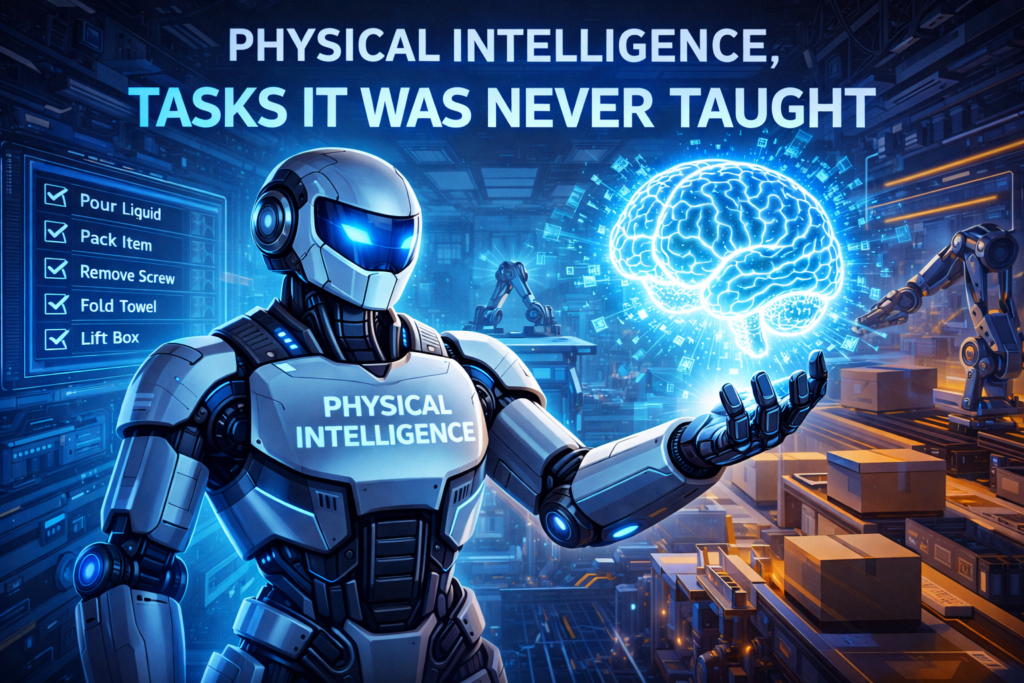
A quiet revolution is reshaping robotics—and it begins not in the mechanical arms or metal joints of machines, but in their ability to think, adapt, and evolve. Physical Intelligence, a fast-rising startup in the robotics scene, has unveiled a new “robot brain” that can figure out tasks it was never explicitly trained to perform. For the AI automation field, this development could mark the turning point where robots cease to be programmed workers and begin to be autonomous learners.
Quick note: Want to automate your operations with AI? Check our [Solutions].
The Rise of Robots That Learn Beyond Instructions
Physical Intelligence’s breakthrough lies in building what they call adaptive “embodied cognition”—an AI architecture that helps machines understand their physical environment and react intuitively. Rather than relying on pre-coded instructions, the robot brain interprets sensory data in real time, forming its own strategies to solve novel problems. Imagine a robot that picks up an unfamiliar tool and figures out how to use it without a single human hint. That’s the new level of independence we’re now witnessing.
Such innovation challenges the long-standing limits of robotic automation. For decades, robots excelled only in constrained, predictable settings—repetitive assembly lines and pre-mapped warehouses. Physical Intelligence’s approach replaces rigidity with fluid intelligence, bringing the adaptability of human reasoning into mechanical systems. It’s no longer about teaching robots every possible variant of a task, but about designing minds capable of deducing what to do when faced with uncertainty or complexity.
The strategic implications reach far beyond industrial productivity. As robots gain the power to infer, anticipate, and generalize, industries from logistics to healthcare could see automation that responds dynamically to context. A surgical robot, for example, could adapt subtly to patient variability, while manufacturing bots could reconfigure workflows when sudden disruptions occur. Adaptive reasoning becomes not just an upgrade—it becomes the foundation for an entirely new model of machine capability.
How Adaptive AI Minds Redefine Automation’s Future
The notion that machines can “figure things out” marks the threshold of true general-purpose robotics. Physical Intelligence’s core algorithms integrate reinforcement learning and embodied simulation, allowing the robot to build causal maps of how its actions affect the world. This allows continuous learning instead of static repetition. In many ways, these robots are beginning to develop something analogous to curiosity—a drive to explore task-space, test hypotheses, and refine their own competence.
At a societal level, adaptive robots will challenge how we define labor, collaboration, and creativity. When machines can extend beyond their programming, they cease to be mere tools and become teammates—agents who participate in problem-solving ecosystems. Future factories might be staffed by adaptive fleets that coordinate autonomously, rebalancing human roles around oversight, design, and ethical governance rather than repetitive execution. The entire structure of work evolves around fluid intelligence embedded in silicon.
This trajectory also underscores why AI governance and interpretability matter now more than ever. As robots learn autonomously, ensuring transparency in their decision-making becomes essential. Universe Agentic readers should view Physical Intelligence’s advancement not just as a technical feat but as an inflection point—a moment demanding frameworks for responsible machine independence. Adaptive AI, when ethically directed, represents humanity’s most powerful ally in building resilient, responsive automation ecosystems.
Physical Intelligence’s self-learning robot brain signals the dawn of a new era in robotics—one where machines no longer wait for instructions but discover solutions through perception and reasoning. For innovators in autonomous systems, the message is clear: the frontier of automation is no longer about replicating human actions; it’s about evolving human-like understanding in machines. As adaptive intelligence becomes the new standard, those who harness it responsibly will shape the architecture of an automated future defined not by programmed limits, but by perpetual discovery.
Ready to lead the AI revolution in your industry? Universe Agentic builds custom autonomous ecosystems that turn complex data into measurable results. [Explore our AI Solutions]