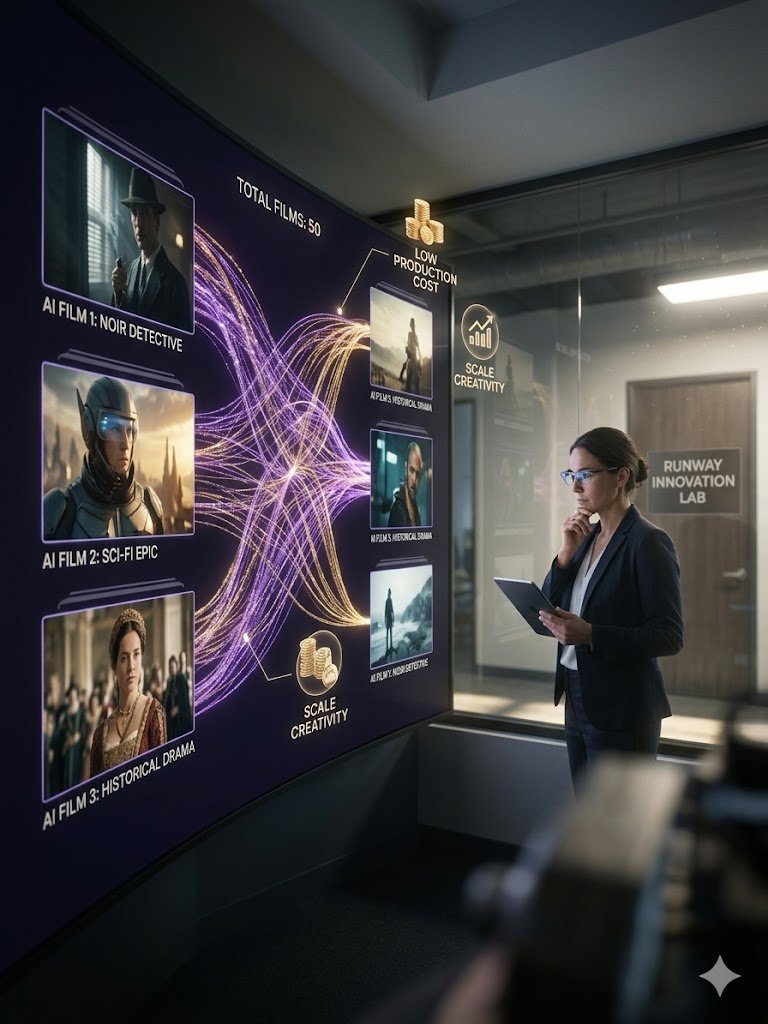
The entertainment industry stands on the edge of a transformation unlike any before it. As artificial intelligence (AI) tools redefine what it means to create, produce, and distribute visual content, even Hollywood’s long-standing model of a $100 million blockbuster is being questioned. In a recent statement, Runway CEO Cristóbal Valenzuela captured this moment succinctly—suggesting that AI could allow Hollywood to make 50 films instead of just one. This vision encapsulates both the economic and creative disruption that generative AI now brings to the heart of storytelling.
Quick note: Want to automate your operations with AI? Check our [Solutions].
AI Promises a Paradigm Shift in Hollywood Filmmaking
Artificial intelligence is not only reshaping workflows—it’s redefining imagination itself. Runway, known for pioneering AI-powered video and image generation tools, sits at the forefront of this shift. The company’s technology enables dynamic visual creation, editing, and even conceptualization without requiring massive production crews or traditional studio infrastructure. Valenzuela’s claim reflects a broader belief in AI’s capacity to multiply creative bandwidth, drastically lowering costs and democratizing access to cinematic production.
In traditional filmmaking, time, talent, and technology often restrict how many stories can be told. With AI accelerators like Runway, however, the bottleneck begins to dissolve. Directors can visualize complex scenes instantly; concept artists can co-create with models that understand cinematic composition; scripts can evolve in real-time through intelligent story agents. These advancements don’t merely save money—they open pathways for creative diversity, allowing more voices and narratives to emerge from the margins.
Still, the transformation requires careful orchestration. As AI tools become creative collaborators rather than just instruments, ethical considerations around authorship, labor, and originality will intensify. Yet the paradigm is clear: with the right frameworks, AI could empower filmmakers to work more efficiently and think more expansively, bridging the gap between artistic ambition and production reality.
From One Blockbuster to Fifty AI-Enhanced Productions
Valenzuela’s notion of producing “fifty films instead of one” is less about quantity for its own sake and more about strategic diversification. Hollywood has long relied on a high-risk, high-reward model—betting heavily on tentpole franchises designed to dominate box offices. AI, however, offers a new model: producing numerous smaller, high-quality films that cater to diverse audiences worldwide. This reinvention could decentralize storytelling power from a few major studios to a global network of agile creators supported by AI-driven pipelines.
Cost efficiency is the immediate gain. Visual effects once demanding massive budgets can now be generated through text-based prompts and procedural AI systems. AI-driven editing, dubbing, and localization can further streamline global distribution, making it feasible to produce multiple culturally localized films simultaneously. Beyond economics, the creative potential is staggering: directors can experiment freely, genres can be blended fluidly, and filmmakers from nontraditional backgrounds can compete at a professional level.
At the strategic level, this change could redefine the purpose of Hollywood itself—from being a geography to becoming a global creative ecosystem. As tools like Runway evolve into autonomous co-directors, the industry’s pace of production, risk management, and cultural experimentation will accelerate. In this model, Hollywood’s greatest blockbuster may no longer be a single film—it could be the collective intelligence of fifty AI-augmented stories reaching audiences everywhere.
What Runway’s CEO articulated is not just a forecast but a framework for the next media revolution. AI’s arrival in filmmaking represents a convergence of automation, creativity, and economic reinvention that may finally decouple storytelling from scale. For professionals in the AI and entertainment sectors, the opportunity lies in architecting systems that turn imagination into production at unprecedented speed. The question is no longer if AI will shape Hollywood’s future—but how intentionally we can design that future to honor creativity, inclusivity, and innovation in equal measure.
Ready to lead the AI revolution in your industry? Universe Agentic builds custom autonomous ecosystems that turn complex data into measurable results. [Explore our AI Solutions]