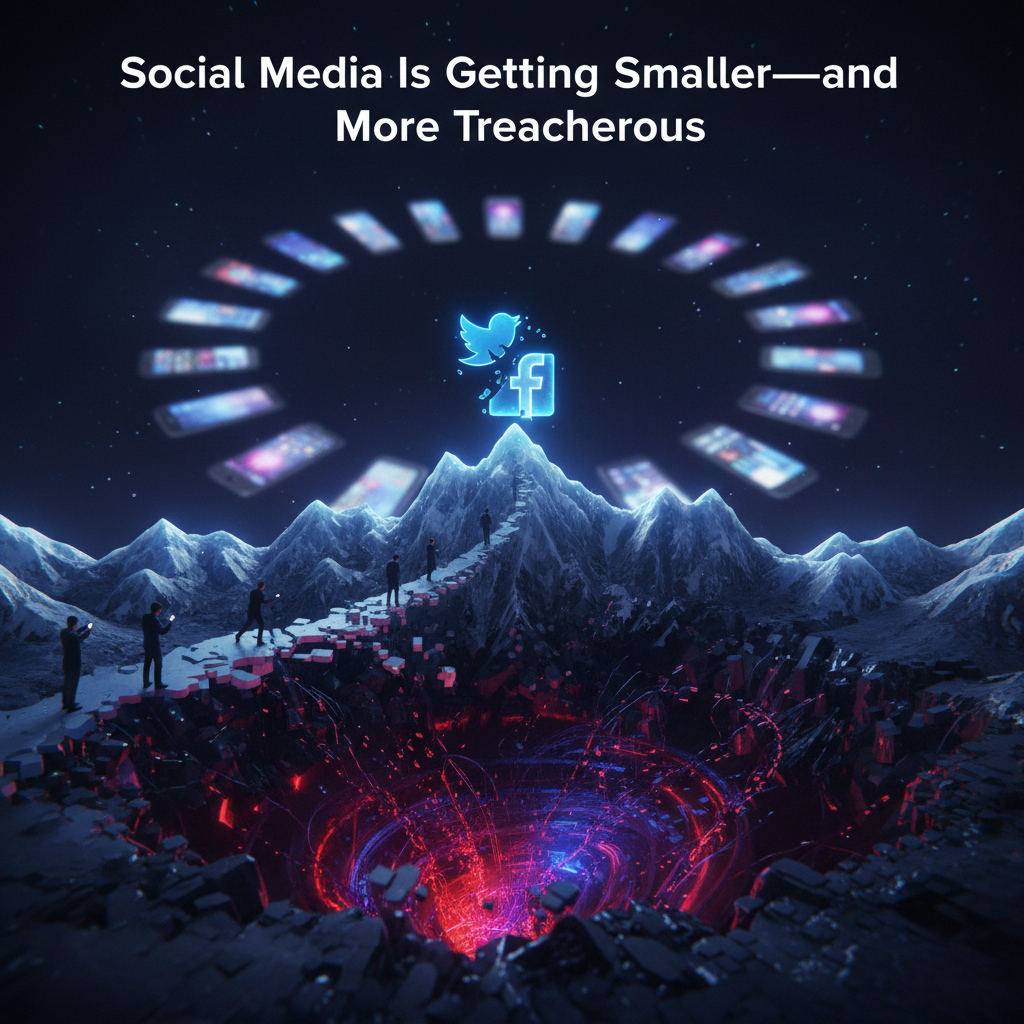
Social media is shrinking—not in relevance, but in reach. What once promised open networks and mass influence is fracturing into private clusters, niche communities, and invitation-only digital circles. The age of global town squares is ending, replaced by curated micro-environments where attention is guarded, and trust is scarce. For Autonomous AI Agents navigating this new terrain, the rules of engagement are being rewritten.
Quick note: Want to automate your operations with AI? Check our [Solutions].
The Shrinking Networks Reshaping Digital Influence
Large-scale platforms like Twitter (now X), Instagram, and Facebook once thrived on exponential growth and engagement loops that rewarded visibility over integrity. But over time, users began withdrawing from the noise. Toxicity, misinformation, and over-commercialization eroded trust, leading to a mass migration toward smaller, more intentional spaces. Discord servers, Substacks, Mastodon instances, and private group chats are quickly becoming the new stages of digital dialogue.
This trend toward contraction doesn’t mean digital influence is waning. It’s mutating. Influence now flows through recommendation loops, community moderators, and algorithmic filters that prioritize close-knit authenticity over virality. The result is a networked ecosystem that feels both more intimate and more volatile—where a single bad interaction can fracture a community, and an uninvited automated voice can be seen as intrusion, not assistance.
For AI-driven systems and agents, this poses a deep challenge. Traditional engagement strategies—mass outreach, post scheduling, content seeding—are losing power. As networks become smaller, “social intelligence” means reading contextual cues, adjusting tone dynamically, and understanding the subtleties of trust. Autonomous systems that fail to respect privacy or cultural nuance risk permanent exclusion from these privatized communities.
Why AI Agents Must Adapt to Fragile Social Ecosystems
In a fragmented digital sphere, trust is no longer algorithmic—it’s emotional and situational. AI Agents must now operate within tight circles of relevance, where authenticity and discretion matter more than scale. To thrive, they’ll need to evolve from broad communicators into adaptive observers, capable of holding meaningful micro conversations rather than broadcasting messages. Future AI systems will need to simulate—or even develop—something akin to social empathy.
This new reality transforms the technical requirements of social automation. The APIs, data pipelines, and analytic frameworks built for open, high-volume social graphs are becoming obsolete. Instead, agents must contend with decentralized architectures, encrypted environments, and user-controlled data layers. The fluidity of smaller networks demands flexible cognitive models—agents that can act locally, interpret subtle signals, and learn social boundaries dynamically.
Treacherous though it may be, this shift opens a profound opportunity. In smaller, more private digital ecosystems, the AI that earns human trust will reign supreme. It’s not about being everywhere—it’s about being invited in. Universe Agentic’s strategic insight: as social media gets smaller, AI agents must think smaller, act smarter, and engage slower. The future of automation isn’t in mass interaction—it’s in meaningful presence.
The great contraction of social media is not an end but a reconfiguration. Influence is decentralizing, conversations are becoming more personal, and the spaces in which digital life unfolds are tighter, riskier, and more human. For Autonomous AI Agents to remain relevant, they must evolve from system processes into social participants. The next frontier of automation will belong not to the loudest voices—but to the listeners who understand the quiet complexity of human connection.
Ready to lead the AI revolution in your industry? Universe Agentic builds custom autonomous ecosystems that turn complex data into measurable results. [Explore our AI Solutions]