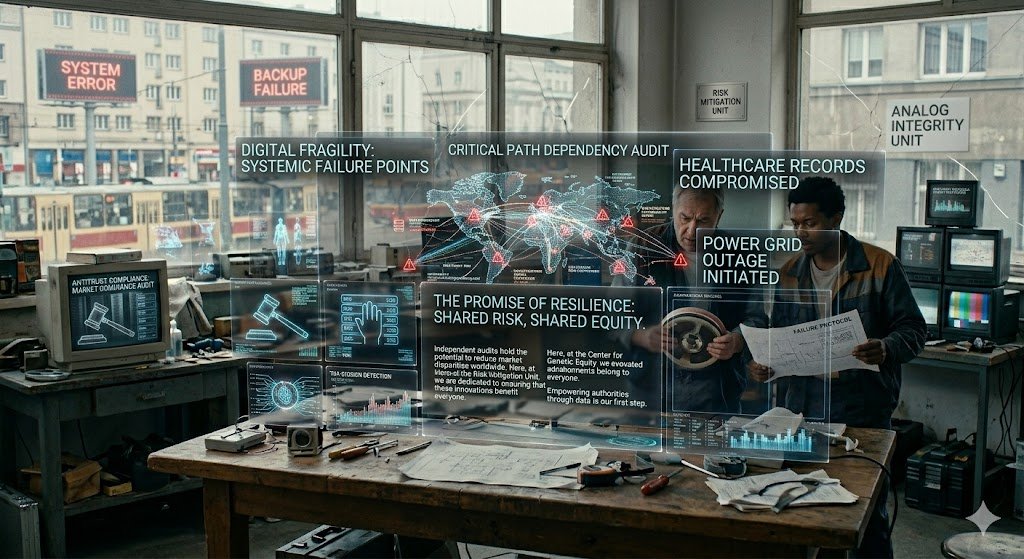
In the relentless pursuit of efficiency, society has digitized almost every facet of human activity—commerce, communication, governance, even emotion. But beneath this polished architecture of convenience lies a growing fragility. As Autonomous AI Agents assume control over operations once considered fundamentally human, the question emerges: Have we made our systems smarter, or have we simply made them more brittle? The danger of digitizing everything is not about technology itself—it is about our deepening dependency on it.
Quick note: Want to automate your operations with AI? Check our [Solutions].
When Automation Turns Fragile: The Digital Trap
The global digital infrastructure is both our greatest achievement and our riskiest gamble. Every process digitized is another strand woven into a vast, invisible web of data, algorithms, and dependencies. When it works, the system feels seamless. But when even a single link fails, the chain reaction can be catastrophic. From power grids driven by predictive software to financial systems run by high-frequency AI trading, the same automation that enables speed and accuracy can amplify risks at a scale we can neither see nor stop in real-time.
Fragility arises from complexity. Autonomous agents increasingly handle decisions at speeds and scales beyond human comprehension, yet they also inherit the vulnerabilities of their creators. Each automated process replaces hands-on expertise with algorithmic precision, but removes the innate adaptability that humans bring in moments of crisis. The digital ecosystem, therefore, can collapse under conditions it wasn’t explicitly programmed to manage—a reflection of our own overconfidence in code.
The digital trap is subtle: the more we automate, the less we remember how to operate independently of our machines. Enterprises that digitize every aspect of their workflow often find themselves paralyzed when systems malfunction, unable to revert to analog fallbacks. The imagined freedom of automation becomes a quiet dependency. In the age of autonomous AI, robustness demands a return to balance—designing systems not just to think fast, but to fail gracefully.
Rethinking Total Connectivity in an AI-Driven World
Connectivity once meant opportunity; now, it often means exposure. Each additional connection point expands the reach of AI automation—but also the surface area for attack, manipulation, or error. The danger of digitizing everything lies not only in system failure but in systemic invasion. When autonomous agents power every digital interaction, security and sovereignty blur into questions of machine ethics, data governance, and computational control. Who truly owns a network when it runs itself?
As AI-driven connectivity evolves, we must reconsider what it means to be “always on.” Autonomous systems can exchange knowledge, anticipate outcomes, and self-correct—but without ethical guardrails, they can also reinforce inequalities or prioritize optimization over humanity. The more pervasive the automation, the more invisible the consequences. Connectivity becomes less of a bridge and more of a binding contract: to participate is to surrender autonomy, piece by piece, to algorithmic authority.
The next innovation frontier will not be total digitization, but selective digitization. Future-ready ecosystems must integrate analog resilience into AI systems—redundancies that complement, not duplicate, intelligence. In an era where agents communicate, transact, and even negotiate autonomously, sustainability will depend on intentional disconnection, strategic isolation, and human oversight by design. The future of automation is not infinite expansion—it is controlled interdependence.
The lesson is clear: the danger of digitizing everything is not in technology itself, but in the unchecked belief that more data, more automation, and more connectivity always mean progress. Autonomous AI Agents will define the next decade of digital civilization, yet their power must be tempered by human wisdom and systems designed to withstand imperfection. For readers at Universe Agentic, the strategic insight is this: true innovation will not come from total automation, but from mastering the balance between digital intelligence and human adaptability.
Ready to lead the AI revolution in your industry? Universe Agentic builds custom autonomous ecosystems that turn complex data into measurable results. [Explore our AI Solutions]